Where Is Your Team on the AI Adoption Curve?
Updated: May 6
How to Spot Early Adopters, Win the Skeptics, and Manage Every Stage of Your AI Rollout
You just rolled out Copilot to your entire department. Two weeks in, three people won't stop talking about it. Twenty-two people haven't opened it once. And that one senior analyst? She's actively lobbying her manager to "get rid of it before it breaks something."
Welcome to the AI adoption curve. Every team follows it, whether leaders plan for it or not.
Understanding the AI Adoption Curve
If you've ever launched a new tool, restructured a process, or introduced a policy change, you've seen this movie before. Some people sprint toward the new thing. Some hang back and watch. Others dig in their heels and wait for it to blow over.
This isn't random. It's the technology adoption curve. This pattern, first described by Everett Rogers in the 1960s, is still the most reliable predictor of how change spreads inside a team. The categories are simple: Innovators, Early Adopters, Early Majority, Late Majority, and Laggards.
What makes AI adoption different is how fast leaders expect everyone to reach the finish line. They often provide little support to those in the middle of the curve. Here's the part most rollout plans miss: roughly 68% of your team lives in the middle two groups. If your AI adoption strategy only serves the enthusiasts, you're planning for 16% of your workforce and hoping the rest figures it out.
Identifying Employee Positions on the Adoption Curve
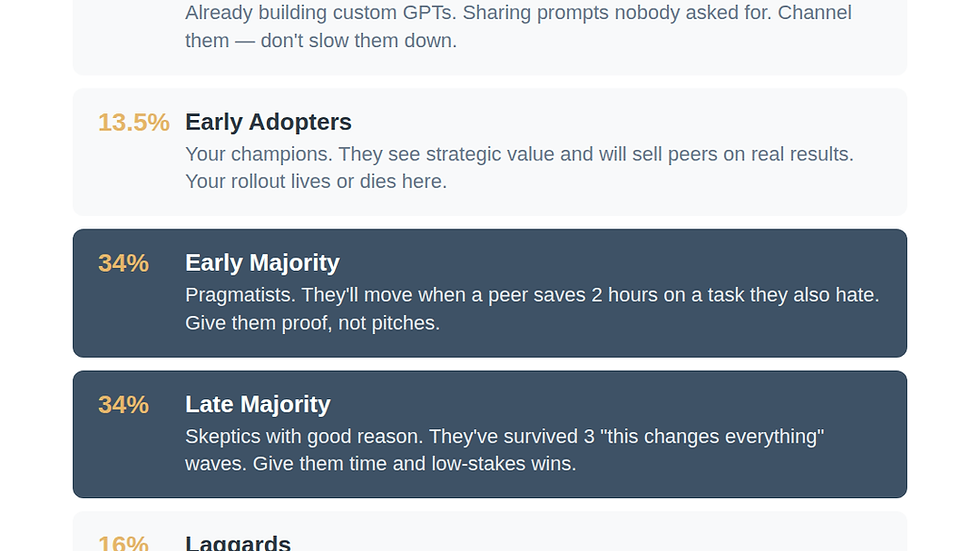
The first step to managing AI adoption is recognizing where people actually are. Here's what each group looks like in practice — not in theory.
Innovators (≈2.5%)
They had Copilot before IT approved it. They're already building custom GPTs on the side. You don't need to motivate them; you need to channel them to prevent shadow IT.
Signs to watch for: Sharing prompts in team channels. Asking IT for API access. Volunteering to demo tools in meetings nobody asked for.
Early Adopters (≈13.5%)
These are your internal champions. They see the strategic value, not just the novelty. They'll try it, refine it, and tell their peers what actually works. Your AI rollout lives or dies on these individuals.
Signs to watch for: Asking thoughtful questions about specific workflows. Saying things like, "Could this help with our monthly reporting?" Willing to experiment but want a clear starting point.
Early Majority (≈34%)
Pragmatists. They'll adopt AI when they see proof it works for someone like them. Not a keynote demo, not an executive mandate, but a peer in their department saving two hours on a task they also hate.
Signs to watch for: Waiting and watching. Attending optional training but not applying it yet. Saying, "That's interesting," but not opening the tool afterward.
Late Majority (≈34%)
Skeptics with good reason. They've survived three "this changes everything" initiatives. They'll move when it becomes harder not to use the tool than to use it — or when everyone around them already has.
Signs to watch for: Quiet resistance. Sticking to old workflows. Comments like, "I don't see how this helps me," or "My way works fine."
Laggards (≈16%)
This isn't a character flaw. Often, these are people with deep expertise in how things work now. They resist because they've built their value on the current system. They'll come around last — or they won't. And that has to be okay, within limits.
Signs to watch for: Active pushback. Framing AI as a threat. Avoiding training entirely. Occasionally, quiet compliance with zero actual usage.
Why AI Rollouts Stall in the Middle of the Curve
Most AI adoption programs over-invest in the ends of the curve. They run advanced workshops for Innovators who don't need them and drag Laggards into mandatory training that breeds more resentment. Meanwhile, the Early and Late Majority — the people who will actually determine whether your AI rollout succeeds — get a launch email and a link to a help article.
Here's the shift: your adoption plan should be weighted toward the middle. Give the Early Majority peer proof and real workflows. Provide the Late Majority time, low-stakes entry points, and visible wins from people they trust. That's how you build AI adoption momentum across the whole curve.
This is where Modern Workery's AI Value Ladder fits naturally. Instead of asking everyone to leap to full automation, you meet each group at their level on the adoption curve:
Assist — AI drafts, you refine (perfect for your Early Majority)
Structure — AI organizes your inputs (where Late Majority can start to see value)
Delegate — AI handles the task end-to-end (where Early Adopters thrive)
Automate — AI runs it without you (Innovators are already here)
Innovators might already be at Delegate. Your Early Majority? They need to start at Assist — and that's a win, not a failure.
Effective Strategies for AI Adoption
Diagnose Your Team's AI Adoption
Before you build another training deck, take 15 minutes to diagnose where your team actually sits on the adoption curve. Use these prompts — with Copilot, ChatGPT, or even just a whiteboard:
Prompt 1 — Segment Your Team on the Adoption Curve: "I'm rolling out an AI tool to a team of [X] people in [department]. Help me create a simple survey (5 questions max) that identifies which employees are Innovators, Early Adopters, Early Majority, Late Majority, or Laggards based on their comfort with AI, past tool adoption behavior, and openness to changing current workflows."
Prompt 2 — Build a Peer-Proof Plan for the Early Majority: "I have 3–4 Early Adopters on my team who are already using Copilot for [specific task]. Help me design a 2-week peer-proof campaign where they share real results with the rest of the team — include a message template, a short demo format, and a feedback loop."
Prompt 3 — Handle Resistance from Late Majority and Laggards: "A senior team member is resisting our AI rollout. They've said [insert their concern]. Help me draft a 1:1 conversation script that validates their concern, reframes AI as a tool that protects their expertise rather than replacing it, and offers a low-risk first step they can try this week."
Prompt 4 — Build an AI Adoption Dashboard: "Help me build a one-page adoption dashboard for my team's AI rollout. I want to track: active users, use cases attempted, time saved, and employee sentiment. Suggest what to measure weekly vs. monthly, and give me 3 leading indicators that adoption is stalling."
Move Your Team Along the Curve — Starting This Week
Every team follows the AI adoption curve. No one skips it. The leaders who get AI adoption right aren't the ones who push the hardest; they're the ones who read the room, meet people where they are, and build momentum from the middle out.
Your Innovators don't need your help. Your Laggards need your patience. But your majority? They need your strategy.
That's the work. It starts with knowing where everyone stands on the adoption curve today.
For those who are still unsure about the value of AI, remember that the right approach can turn your investment into measurable results. By understanding the adoption curve and tailoring your strategy accordingly, you can help your team embrace AI effectively.


Comments